
Compressed & Roll-Packed Mattresses: A Buyer’s Guide to Packaging and Bulk Shipping
Compression packaging can reduce the space required for mattress handling and transport, but the right method depends on the mattress construction, materials, finished dimensions and shipping requirements. Buyers should understand how vacuum compression, roll-pack, flat compression and box packaging differ before approving a bulk-order packaging plan.
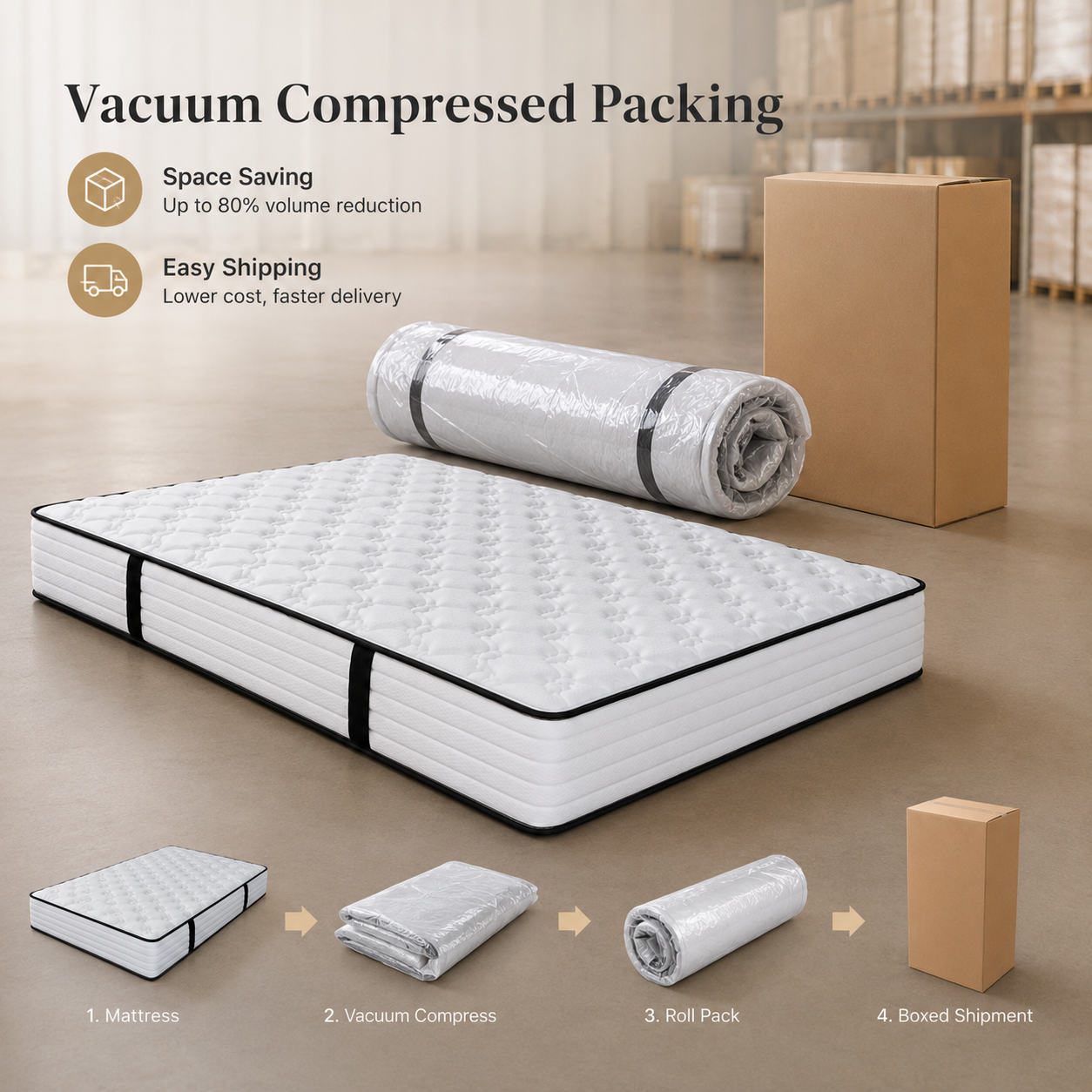
1. What Is Mattress Compression Packaging?
Mattress compression packaging reduces the packed volume of a mattress by applying controlled compression before shipping. Depending on the mattress construction and logistics plan, the compressed product may be rolled, kept flat or placed into a carton for distribution.
These terms are related, but they do not describe exactly the same packaging method.
Vacuum Compression
Air is removed from the sealed package while the mattress is compressed to reduce its packed volume before the next packaging stage.
Roll-Pack
After compression, the mattress is rolled into a compact cylindrical form for handling, carton packing or bulk shipment.
Flat Compression
The mattress is compressed but remains in a flat format rather than being rolled, depending on the product structure and shipping plan.
Mattress in a Box
This describes the final boxed format. A mattress in a box may use vacuum compression and roll-packing, but the terms are not interchangeable.
Key takeaway: Buyers should confirm the actual compression method, final package format and whether the mattress construction is suitable for the proposed packaging process.
2. Why Are Mattresses Compressed for Bulk Shipping?
Mattress compression packaging is mainly used to make finished products more compact for transport, storage and handling. For bulk orders, the packaging format should be considered together with mattress construction, carton dimensions, loading plans and the buyer’s distribution model.
The objective is not simply to make the mattress smaller. A suitable packaging plan should protect the product while supporting efficient handling from production through warehousing, shipping and final distribution.
A more compact package can make transport and warehouse planning easier.
Consistent packed dimensions help buyers plan cartons, SKU mixes and shipment loading.
Compact formats can make individual units easier to move through warehouses and distribution channels.
Boxed or roll-packed formats can be coordinated with retail presentation and fulfillment requirements.
Buyer note: Actual shipping efficiency depends on mattress size, construction, packaging dimensions, order mix and destination. It should be confirmed for each project rather than assumed from a fixed loading formula.
3. Which Mattress Types Can Be Compressed or Roll-Packed?
Many mattress types can potentially use compression packaging, but suitability depends on the specific construction, materials, mattress height and the proposed packaging method. Buyers should avoid assuming that every foam, spring or hybrid mattress can be packed in the same way.
The final decision should be based on how the mattress responds to compression, whether the edges and comfort layers remain stable, and whether the finished product can recover to the approved specification after unpacking.
Often suitable for compression, depending on foam structure, density and finished height.
May be suitable when the spring system, comfort layers and edge construction are compatible with compression.
Can be considered for compression when the construction and top profile tolerate the selected method.
Usually requires closer review because added comfort layers and greater top depth can affect compression suitability.
Key takeaway: Mattress type alone does not determine packaging suitability. The complete construction should be reviewed before approving vacuum compression or roll-pack packaging.
Buyers can also review SomnuSleep’s mattress types and constructions when comparing products for different packaging requirements.
4. Roll-Pack vs Flat Compression vs Mattress-in-a-Box
These packaging formats are related, but they describe different stages or final forms of mattress packaging. Buyers should compare the finished package format, handling requirements and intended sales channel before approving a packaging plan.
| Comparison | Roll-Pack | Flat Compression | Mattress in a Box |
|---|---|---|---|
| Final format | Compressed and rolled | Compressed but kept flat | Compressed mattress packed into a carton |
| Handling | Compact cylindrical format | Flat package for stacking or handling | Boxed format for storage, retail or fulfillment |
| Packaging focus | Roll diameter and protection | Flat dimensions and surface protection | Carton dimensions, labeling and presentation |
| Common use | Bulk shipping and distribution | Selected project or logistics requirements | Retail, e-commerce and boxed distribution |
| Buyer should confirm | Construction tolerance and final roll size | Flat-pack dimensions and handling method | Box size, labels, barcode and packaging presentation |
5. What Should Buyers Check Before Approving Compression Packaging?
Compression packaging should be approved as part of the mattress specification, not treated as a separate shipping decision. The mattress structure, packed dimensions, product protection and final presentation should all be reviewed together.
Buyers should also confirm the packaging with the approved mattress sample before bulk production, especially when roll-pack or boxed formats are required.
Confirm that the support system, comfort layers and edge structure are suitable for the proposed compression method.
Confirm the final roll, flat-pack or carton dimensions required for handling and shipping.
Check whether the approved mattress returns to the expected shape and specification after unpacking.
Review fabric, corners, edges and protective materials used during compression and transport.
Confirm product labels, barcode placement and required carton information before production.
Approve the final packaging format together with the mattress sample before bulk production.
Buyer note: Recovery performance, packed dimensions and packaging suitability should be verified for the actual mattress specification rather than assumed from another model.
6. Packaging Options for Wholesale and Private-Label Orders
Mattress packaging can be adapted to different sales channels, branding requirements and distribution models. Buyers should define the required carton, labels and product information before the packaging sample is approved.
Standard Packaging
Suitable for projects requiring practical product protection, transport handling and straightforward packaging presentation.
Private-Label Packaging
Suitable for branded collections requiring logos, labels, carton graphics and consistent product presentation.
Retail & E-commerce Packaging
Suitable for retail or e-commerce orders requiring barcodes, instructions, handling details and product presentation.
Buyers developing branded mattress collections can review SomnuSleep’s custom packaging and private-label options.
7. What Should Buyers Consider for Bulk Mattress Shipping?
Bulk mattress shipping should be planned around the final packed dimensions rather than the uncompressed mattress size alone. Carton format, SKU mix, order quantity, destination and warehouse handling can all affect the loading plan.
Buyers should confirm these details before production so packaging, labeling and shipment preparation can be coordinated with the actual order.
Buyers can also review SomnuSleep’s compression packing and factory capabilities when evaluating production and shipment preparation.
Confirm the finished carton, roll or flat-pack dimensions used for loading and handling.
Plan different mattress sizes and models together when preparing a mixed-order shipment.
Consider warehouse access, local handling and the buyer’s distribution requirements.
Review the actual order mix before estimating container or shipment utilization.
Confirm cartons, film and protective materials are suitable for the planned transport route.
Buyer note: Container quantities and loading efficiency vary by mattress specification, packaging format and order mix. They should be calculated for the actual order rather than treated as fixed values.
8. Questions to Ask Before Approving Roll-Pack Packaging
Before approving a roll-pack or compressed packaging plan, buyers should confirm how the proposed method fits the mattress specification, labeling requirements and shipment plan.
01 — Is the mattress construction suitable for the proposed compression method?
Confirm that the support system, comfort layers, edge structure and finished height can tolerate the selected packaging process.
02 — What will the final packed dimensions be?
Confirm the roll diameter, flat-pack size or carton dimensions needed for handling and shipment planning.
03 — Has the packaging method been tested with the approved mattress sample?
Review the actual packed and unpacked sample before bulk production.
04 — How are labels, barcode and carton information confirmed?
Check placement, product identification and any buyer-specific packaging requirements before production.
05 — How will mixed sizes or SKUs be handled?
Confirm how different models, sizes and packaging formats will be coordinated within the shipment plan.
06 — What should be approved before loading begins?
Confirm the final packaging specification, carton details, labels and order mix before shipment preparation.
Buyer note: The approval process should be based on the actual mattress and packaging specification for the order, not on assumptions from another model.
9. Mattress Packaging Approval Checklist
Before bulk production and shipment planning, buyers can use this checklist to confirm the main product, packaging and logistics requirements.
Product Specification
Packaging Details
Approval & Shipping
Final check: The approved packaging specification should match the actual mattress, order mix and shipment requirements before production begins.
Need Help Confirming Your Mattress Packaging Plan?
Share your mattress specifications, order requirements, packaging format, branding and shipping needs with our team. We can help review suitable compression, roll-pack and carton options before bulk production.