
How Should Buyers Specify Mattress Height for Wholesale & Hotel Projects?
Mattress thickness and finished height should be defined as part of the complete product specification rather than selected as an isolated number. For wholesale, retail, private-label and hospitality projects, the appropriate mattress height depends on the construction, product positioning, intended application and approved sample.
Buyers should consider how the support system, comfort layers, quilting, top construction and overall layer build contribute to the finished mattress height. A target such as “10-inch” or “12-inch” is more useful when it is connected to a clear construction and product specification.
For hotel and project orders, mattress height should also be reviewed together with the bed base, bedding, finished bed height and other application requirements before bulk production.
1. What Does Mattress Height Mean for Professional Buyers?
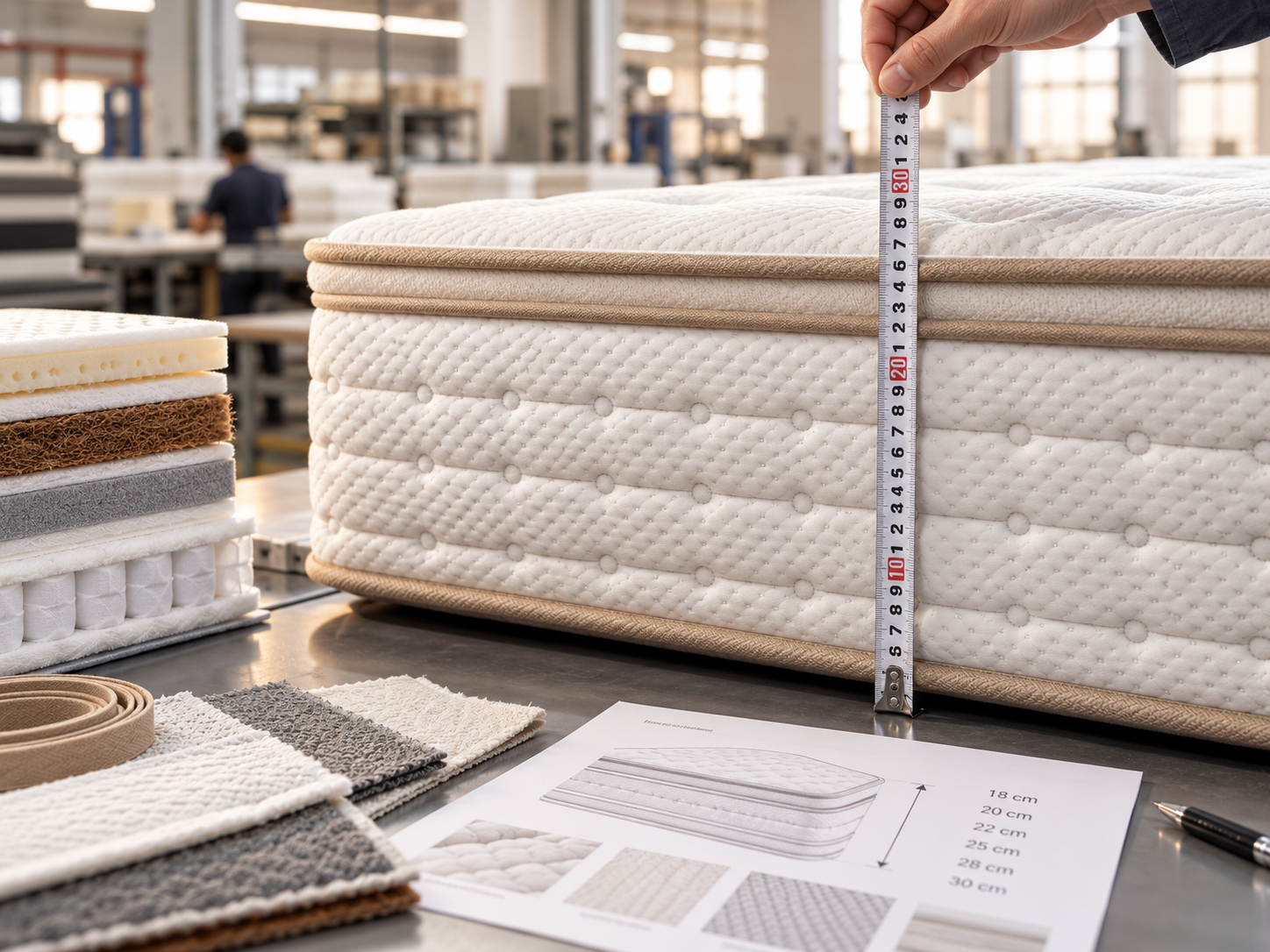
Mattress height refers to the finished overall thickness of the completed mattress. For professional buyers, it should be treated as part of the complete product specification rather than as a standalone product label.
A target such as 10-inch or 12-inch describes the finished profile, but it does not explain how the mattress is constructed. Two mattresses with the same finished height can use different support systems, comfort layers, quilting and top constructions.
Buyers should therefore confirm mattress height together with the intended construction, product positioning, target application and approved sample before bulk production.
Mattress Height Specification Reference
Confirm the overall height of the completed mattress rather than only the thickness of individual layers.
Review how the support core, comfort layers, quilting and top construction contribute to the finished profile.
Consider whether the mattress is intended for retail, hospitality, private-label or project use.
Use the finished sample as a practical reference for confirming the agreed mattress height before bulk production.
Buyer takeaway: A mattress height number is only meaningful when it is connected to an agreed construction and approved specification.
2. Why Does Mattress Thickness Not Define Quality by Itself?
A thicker mattress is not automatically a higher-quality mattress. Finished height is only one part of the product design, while the actual construction determines how the mattress is built, positioned and approved.
Two mattresses with similar finished heights may use very different support systems, comfort-layer combinations, quilting structures and top designs. Likewise, a thinner mattress can still be suitable for a particular retail, hospitality or project specification when the construction is designed for that application.
For professional buyers, mattress thickness should therefore be evaluated together with the complete product specification rather than used as a shortcut for judging quality, comfort or market positioning.
01 — Support Structure
The main support system can use foam, pocket springs, hybrid construction or another agreed structure.
02 — Comfort Layer Build
Foam type, layer sequence and comfort materials can change the total mattress profile without defining quality by height alone.
03 — Surface Construction
Quilting, cover structure and top design can add to the finished height and affect the overall product profile.
04 — Product Specification
The intended market, application, construction and approved sample should be considered together when evaluating mattress height.
Important distinction: Mattress height can support product positioning, but it should not be treated as a universal quality grade. A 12-inch mattress is not automatically better than a 10-inch mattress simply because it is thicker.
3. What Construction Factors Affect Mattress Height?
Mattress height is the result of the complete construction rather than one individual component. Buyers should review how the support system, comfort layers, quilting and top profile combine to create the required finished mattress height.
Different mattress constructions can reach similar finished heights in different ways. A foam mattress, pocket spring mattress or hybrid mattress may therefore use different internal structures even when the finished profile appears similar.
01 — Support System
The main support structure may use foam, pocket springs, hybrid construction or another agreed system. Its design forms the foundation of the overall mattress build.
02 — Support-Core Height
The height of the spring unit or foam support core can influence how much of the finished mattress profile comes from the main support structure.
03 — Comfort Layers
Foam, memory foam, latex and other comfort materials can be combined in different thicknesses and sequences above the support structure.
04 — Quilting & Cover Structure
Quilting materials, cover construction and surface padding can contribute to the finished mattress profile and overall appearance.
05 — Top Construction
Tight Top, Euro Top and Pillow Top designs use different upper constructions and can affect the finished profile, but top style should not be treated as a fixed indicator of mattress height.
06 — Overall Layer Build
The finished height should be confirmed from the complete assembled mattress rather than calculated from one layer or component in isolation.
Buyer note: Two mattresses with the same finished height may use different internal constructions. Buyers should confirm both the target height and the approved layer build before bulk production.
Buyers comparing different support systems can also review our Pocket Spring vs Foam Mattress Buyer’s Guide.
4. How Should Wholesale and Retail Buyers Plan Mattress Height?
Wholesale and retail buyers should plan mattress height around the target market, product positioning and collection structure rather than assuming that one height is suitable for every product.
Different finished heights may help distinguish products within a collection, but height alone should not be used as a fixed indicator of quality, comfort or price level. Buyers should consider how the mattress construction, visual profile, bedding compatibility and retail presentation support the intended product direction.
For repeat orders, the target height should be connected to a defined construction, approved specification and sample so the same finished profile can be reproduced consistently.
Buyers planning a broader product range can also review SomnuSleep’s mattress collection when comparing mattress constructions and product positioning.
What Buyers Should Consider
Define the intended market, customer segment and product positioning.
Decide whether different products require different finished heights or whether a consistent profile is preferred across the range.
Coordinate mattress height with the intended entry, mid-range or premium positioning without treating height alone as a quality grade.
Consider how mattress proportions, bed display, bedding and overall product appearance fit the retail environment.
Use the approved construction, specification and sample as references when reproducing the same mattress height in later orders.
Buyer takeaway: Mattress height should support the product range and target market, not be treated as an isolated product feature.
5. How Should Hotels and Hospitality Buyers Specify Mattress Height?
Hotel and hospitality buyers should specify mattress height as part of the complete bed system rather than considering the mattress alone. The appropriate finished height can depend on the bed base, foundation, bedding, room design and approved project specification.
A mattress that is suitable for one property may not automatically suit another. Buyers should consider how the finished mattress height works with the existing furniture, headboard proportions, fitted sheets, mattress protectors and the intended overall bed height.
For project orders, consistency is especially important. The agreed mattress height should be confirmed together with the construction and approved sample so the same finished profile can be reproduced across the required rooms or replacement orders.
Buyers planning hospitality projects can also review SomnuSleep’s hotel mattress solutions for mattress construction, customization and project requirements.
Hotel Mattress Height Planning Factors
Confirm how the mattress height works with the selected bed base, foundation or platform.
Review the combined height of the mattress and supporting base rather than considering mattress thickness alone.
Consider fitted sheets, mattress protectors, encasements and other bedding requirements where applicable.
Check how the finished bed profile works with headboards, bedside furniture and the intended room design.
Use the approved specification and sample to maintain the same finished mattress profile across the project.
Buyer takeaway: For hospitality projects, mattress height should be reviewed together with the bed base, bedding and room specification as one finished bed system.
6. How Should Private Label Buyers Define Mattress Height?
Private-label buyers should define mattress height together with the complete construction rather than treating the finished height as an isolated requirement. A target such as 10-inch or 12-inch should be supported by an agreed layer build, support system, firmness direction and top construction.
The same finished height can be achieved through different constructions, so the buyer and manufacturer should confirm how the required profile will be built before sampling and bulk production.
For branded products, the approved sample becomes an important reference for confirming the finished height, overall proportions, surface appearance and construction before the specification moves into repeat production.
Define the Construction
Confirm whether the mattress uses foam, pocket springs, hybrid construction or another agreed support structure.
Define the required comfort materials and layer sequence that contribute to the finished mattress profile.
Record the required overall mattress height as part of the complete product specification.
Confirm the intended firmness together with the construction rather than assuming height determines the feel.
Define whether the product uses Tight Top, Euro Top, Pillow Top or another agreed upper construction.
Buyers developing branded products can also review SomnuSleep’s mattress customization options for structure, materials, size and product-development requirements.
Approve the Finished Product
Check that the completed sample matches the agreed overall mattress height.
Review how the mattress profile, side panel and top construction appear as a finished product.
Confirm that the internal build reflects the approved support system and comfort-layer specification.
Review the finished sample against the intended firmness and overall product positioning.
Keep the approved specification and physical sample as references for bulk production and repeat orders.
Buyer takeaway: Target mattress height should be translated into an approved construction and sample rather than treated as a standalone number.
7. Does Mattress Height Determine Firmness?
Mattress height and mattress firmness are related to the overall construction, but they are not the same specification.
A thicker mattress is not automatically softer, and a thinner mattress is not automatically firmer. The finished feel depends on how the support system, comfort layers, quilting, top construction and other materials work together.
Two mattresses with similar heights can therefore have different firmness directions, while mattresses with different finished heights may still be developed toward a similar comfort target.
For professional buyers, height and firmness should be confirmed separately within the product specification and then reviewed together on the approved sample.
Buyers who need to define the target comfort direction can also review our Mattress Firmness Guide for Wholesale & Hotel Buyers.
Height Is Not the Same as Firmness
Describes the overall thickness of the completed mattress.
Describes the intended overall comfort feel of the finished product.
Provides the practical reference for confirming how the agreed construction performs as a finished mattress.
Buyer takeaway: Do not use mattress thickness alone to predict firmness. Confirm both height and comfort direction against the approved construction and sample.
8. How Does Mattress Height Affect Packaging and Logistics?
Mattress height can affect packaging and logistics, but the impact depends on the complete mattress construction and the approved packing method rather than on finished height alone.
A taller mattress may use a different layer build, spring system or comfort construction, which can influence whether the product is suitable for flat packing, compression, roll-pack or another agreed format. Buyers should therefore review mattress height together with the intended packaging method during product development.
Packed dimensions, carton requirements and handling considerations should be confirmed from the actual approved product and packaging specification. They should not be estimated only from the mattress’s finished height.
For bulk and e-commerce orders, packaging should be approved together with the mattress specification so the finished product, carton and identification requirements remain aligned before production and shipment.
Buyers who need a broader explanation of compression, roll-pack and bulk-shipping formats can also review our Mattress Packaging & Bulk Shipping Guide.
Packaging Factors Buyers Should Review
Confirm whether the approved mattress will be flat-packed, compressed, roll-packed or packed using another agreed method.
Review whether the mattress construction and materials are suitable for the intended packaging process.
Confirm packed dimensions from the approved mattress and packaging format rather than estimating them from finished height alone.
Define carton requirements, barcode, SKU identification and other packaging information where applicable.
Consider how the approved package will be handled, stored and distributed through the intended sales or project channel.
Buyer takeaway: Finished mattress height can influence packaging decisions, but packing requirements should always be confirmed from the actual construction and approved packaging plan.
9. How Should Different Buyers Approach Mattress Height?
Mattress height decisions should reflect the buyer’s business model, target market, product construction and application requirements. Different purchasing scenarios may prioritize different factors, but none should rely on mattress thickness alone.
The following table provides a practical reference for comparing the main height and thickness considerations across wholesale, retail, private-label and project applications.
| Buyer Scenario | Main Height & Thickness Considerations |
|---|---|
| Wholesale Collection | Target market, collection structure, mattress construction, product differentiation and repeat-order consistency. |
| Retail Range | Product positioning, visual profile, bedding compatibility, retail presentation and overall product mix. |
| Private Label Brand | Target finished height, layer build, support system, approved specification and sample reference. |
| Hotel Project | Bed base, finished bed height, bedding requirements, room proportions and consistency across the project. |
| Apartment / Rental Project | Existing furniture, target bed profile, project positioning, mattress construction and repeatability across units. |
| E-commerce Collection | Mattress construction, product positioning, packaging compatibility, packed dimensions and repeatable specification. |
10. Mattress Height Specification Checklist for Buyers
Before approving a mattress height for bulk production, buyers should confirm the market, construction, application and reference requirements that define the finished product profile.
The checklist below can be used as a practical reference when preparing a wholesale, retail, private-label or hospitality mattress specification.
Market & Product Direction
Construction & Height
Application & Approval
Final check: The target mattress height should be supported by the approved construction, finished sample and written specification before bulk production begins.
Buyers preparing the complete product brief can also review our Mattress Specification Checklist for Wholesale & Private Label Buyers.
11. Why Should Buyers Confirm Mattress Height on the Approved Sample?
An approved sample gives buyers a practical way to confirm whether the specified mattress height has been translated into the intended finished product.
The written specification may define the target height, construction and materials, but the completed sample allows the buyer to review how those elements work together in the actual mattress. This is especially important when different layer builds or top constructions can produce similar nominal heights but different finished profiles.
Before bulk production, buyers should review the sample against the latest approved specification and confirm the finished height together with the overall construction, proportions, firmness direction and surface appearance.
Once approved, the specification and physical sample can serve as references for bulk production, repeat orders and later quality-control checks.
What Buyers Should Confirm on the Sample
Check the overall mattress height against the agreed specification.
Review the side profile, top construction and finished appearance.
Confirm that the support system and layer build match the approved product direction.
Review the finished comfort direction separately from the mattress height.
Keep the latest approved specification and sample as references for bulk production and repeat orders.
Buyer takeaway: The target mattress height should not move into bulk production until the finished sample and written specification are aligned.
Planning a Mattress Collection or Hotel Project?
Share your target market, mattress construction, finished height, firmness, packaging and project requirements with our team.
We can help review the product direction, construction options and specification details before sample development and bulk production.